
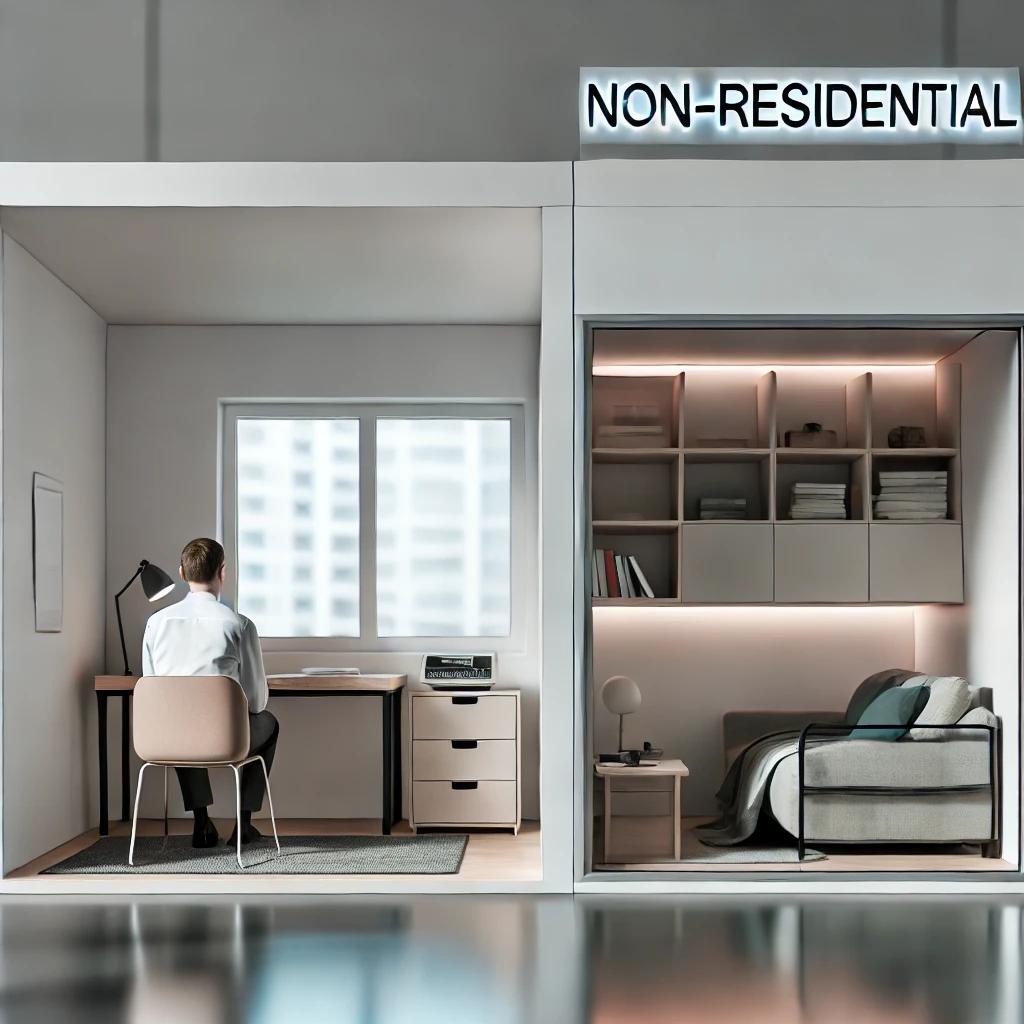
In light of current regulations, a person living in a non-residential room may face a fine. So how can one legalize the change of use of a non-residential property?
Changing the purpose of a room in a building without appropriate notification to the office is a violation of building law. This is true even when the non-residential room is adequately equipped, allowing for comfortable use and not requiring significant alterations to the building or architectural or sanitary transformations.
Apartment vs. non-residential property – differences
First, it is worth mentioning what the difference is between an apartment and a service premises. A non-residential premises is a room or several non-residential rooms, isolated by walls made of durable materials, where service, commercial, or storage activities are most often conducted. It does not constitute a room of a technical, economic, or residential nature.
An apartment is one or several rooms, isolated by walls made of durable materials, located within a single building, having a separate entrance, where a group of people lives together.
A basement, garage, or attic belongs to both non-residential and residential premises.
Both terms are very similar. A utility room and an apartment differ in terms of the purpose for which they are used. A residential premises and a non-residential room should meet established technical conditions according to the relevant regulation.
How to convert a utility room into an apartment?
The indicated differences between an apartment and a utility room compel us to ask the following question: do I have the right to live in a utility room? The Act of July 7, 1994 regulates the issue of changing the purpose of a non-residential room or building, which involves a complete change in the character of the building's use and conditions: work, load size, fire protection, health, hygiene, and sanitary conditions. Where to start? First, change the character of the use of the room/building, and then acknowledge that the character of the use of the property has indeed changed. Converting a utility room into a residential room or an apartment into a non-residential premises is the result of a decision to change the character of the use of the premises/building.
When there is a need to determine whether there has indeed been a change in the way the room/building is used, a comparison is made between its previous use and the current character of the use of the service room.
Where to report the intention to change the way of use?
A person intending to change the way of using a non-residential room or building should report this to the appropriate authority. We do not report the intention to carry out architectural or sanitary alterations. In the notification, we declare our intention to change the way of using the non-residential building, presenting to the construction supervision the previous character of the use of the room and the planned changes.
What are the consequences of not reporting the change in the way of using a non-residential premises?
Before deciding to change the character of the use of the building, you must submit the appropriate statement/notification to the office. If you report changes after they have been made, such a statement is ineffective. This raises the following question: who should report the change in the character of the use of the premises? The owner or the property manager, as they are the ones responsible for the proper use of the property. Inspectors from WINB or PINB conduct proceedings regarding the illegal change in the way of using the building/room.
Even if the room did not need renovation, and its interior, as well as sanitary facilities, allowed for immediate conversion of the non-residential room into an apartment, the owner may be held responsible for changing the way of using the premises without permission. If the construction supervision (nb) finds that there has been an unlawful change in the character of the use of the building, it may require the submission of appropriate documents and suspend the use of the building or its part.
After the deadline for submitting documents has passed, nb checks whether the owner has fulfilled all requirements. If the building is still being used for purposes other than the original, it will issue a decision to restore the legal way of using the building or its part.
Step by step, how to legalize a residential premises
After the owner or property manager submits all necessary documents, the appropriate nb authority will determine the amount of the legalization fee. The investor can file an appeal to WINB or (if WINB issued a ruling in the first instance) to GINB. If the fee is not paid within the specified time (seven days), it is subject to collection in the manner specified for enforcement costs in administration. The governor has the authority to collect the fee.
WORTH KNOWING
Fine for unlawful change in the character of the use of the building or its part
Remember that even if you have paid the legalization fee, you may still face a fine for the offense of unauthorized change in the use of the premises. GINB can impose a fine of up to 2000 zł. Every citizen has the right not to accept a fine.